How to Read a Merchant's Ads and Ratings on P2P
You have a list of P2P ads in front of you and the cheapest one is not always the one to pick. Each ad tells you how many orders the advertiser finished, how often they completed them, how much you can trade and how long you have to pay. Read those, then read the ad's own terms, and you will skip most of the people you should not trade with.
In this guide
The P2P list looks like a price board, so most people sort by price and tap the top ad. That works most of the time. When it does not, the warning signs were usually already on the screen, in the small grey numbers under the advertiser's name and in the text they wrote on the ad.
Here is how I read an ad before trusting someone with my naira or my coins, using Bybit's NGN market as the example.
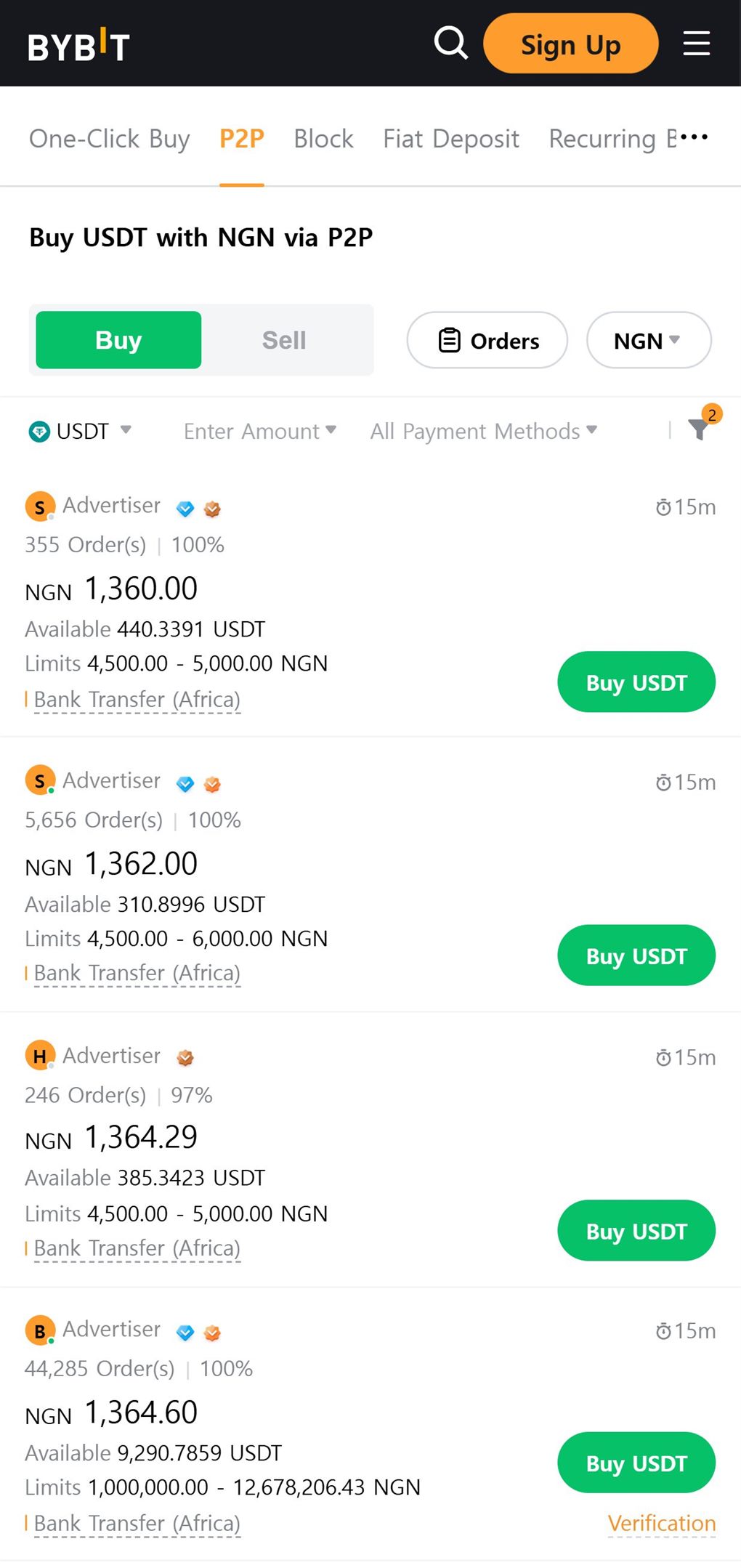 Bybit P2P buy ads for NGN on 12 October 2026. Advertiser names hidden.
The numbers on the card
Each ad card in the screenshot carries the same pieces of information.
Orders and completion rate. The first ad shows "355 Order(s) | 100%". The first figure is how many orders the advertiser has done. The second is the completion rate. Bybit calculates it as completed orders divided by total orders, over the last 30 days. A 97% rate, like the third ad, means a few recent orders did not finish.
A lower rate is not proof of bad behaviour. Bybit counts it against the buyer when a buyer cancels, unless the buyer marks the cancellation as the seller's fault and the seller accepts that. So an advertiser who buys a lot can see their rate dip because of their own cancellations. Still, for a first trade, I would stick to people above about 98% with a few hundred orders behind them.
Price. The naira price per USDT. On the buy side, the lowest prices tend to sit near the top. On 12 October 2026 the first four ads ran from ₦1,360 to ₦1,364.60.
Available and limits. "Available" is how much USDT the advertiser still has on that ad. The limits are the smallest and largest naira amounts you can trade with them in one order. The first three ads in the screenshot only accepted ₦4,500 to ₦6,000, while the fourth started at ₦1,000,000. If your amount does not fit, the ad is not for you, however good the price.
Time limit. The clock icon shows how long you have to pay once the order opens, 15 minutes on every ad here. If your bank is sometimes slow, a longer window is worth a slightly worse price.
Payment method. The underlined label, "Bank Transfer (Africa)" here. Pay only with a method the ad lists, from an account in your own name. Bank Transfer vs Fintech Apps for P2P in Nigeria covers how the methods differ.
What the badges mean
Bybit has three kinds of advertiser. General advertisers can post ads once they meet basic rules. Verified advertisers have applied and been approved, and come in Bronze, Silver and Gold tiers, each with its own badge. Block advertisers trade larger amounts, from 10,000 USDT per order.
To become a verified advertiser, Bybit says applicants go through a review that can take up to 15 working days, and that rejected applications often fail on things like incomplete bank account history or proof of where their coins came from. Advertisers also lose the right to post ads if their 30-day completion rate falls below 80%.
So a badge tells you that someone passed a check and keeps a decent record. It does not tell you they are honest on this particular trade. Treat it as a reason to look further, not a reason to stop looking.
In the screenshot, the fourth ad also shows an orange Verification label next to the button. Bybit lets verified and block advertisers ask takers to provide extra verification before trading. Expect to be asked for something before the order goes ahead.
Why the order of ads is not a ranking of honesty
It is tempting to assume the top ad is the best. Bybit's own rules show why that is not quite true.
For NGN, Bybit says ads are ranked by a weighted mix of the advertiser's completion rates (overall and 30-day), advertiser type, how close the price is to the average market price over the past hour, and the minimum trade amount, with lower minimums shown first. Ads flagged as suspicious or misleading are pushed down, and advertisers with fewer than 30 days of history cannot appear in the top 20 (Bybit Help Centre, updated 6 October 2026).
That last part explains why small ₦4,500 ads crowd the top of the screen. It also means the ad you need for ₦300,000 might be further down. Scroll, or type your amount into the Enter Amount filter so only ads that fit are shown.
There is one more quirk. Users who have never completed a P2P trade may see "Top Picks for New Users" first. These are small ads, up to 100 USDT, from verified advertisers. That is a sensible place to start.
Read the ad text, every time
Tap an ad and you will usually see a note from the advertiser. This is where they set their terms, and it tells you a lot.
When I looked at the NGN list in October 2026, notes included "no third party payment", requests not to use a particular payment provider, and requests to "drop receipt after payment". Those are normal. Advertisers who refuse third-party payments are protecting themselves and you.
Some notes deserve more care:
- An account name or number written in the note. Pay only to the account shown on the order screen after you place the order. If the two do not match, stop and ask in the order chat.
- Anything that moves you off the platform. A phone number, a WhatsApp or Telegram link, or "message me first". Bybit says it does not take responsibility for trades made through private channels, and its appeal team only sees what happens in the order chat.
- Instructions about what to write in the transfer narration. Some advertisers ask buyers to avoid certain words. You can follow a reasonable request, but never agree to describe the payment as something it is not.
- Pressure. "Pay fast or I cancel", or "release now, money is coming". A real trader will wait for you to check.
The profile behind the ad
Tap the advertiser's name to open their profile. You will see more of their trading record there. You can also add a private note, which Bybit calls a Remark, only you can see. If a trade goes well, add a note so you can find that person again. If something felt off, note that too.
If someone ever cheats you, the P2P Scams in Nigeria guide lists the common tricks, and What to Do If You Have Been Scammed in a P2P Trade covers the next steps.
Choosing between two decent ads
Say two ads fit your amount. One is ₦1,362 per USDT from an advertiser with 5,000 orders and 100%. The other is ₦1,358 from someone with 40 orders and 95%. On ₦200,000, the cheaper ad saves you about ₦590 worth of USDT. That is real money, but it is also the price of an extra risk. For a first few trades I would pay it. Once you know the process well and keep amounts small, the cheaper ad becomes more reasonable.
The same reading applies when you sell, with one change. As a seller you are trusting the buyer to pay with clean money from their own account, so the buyer's record matters even more. Check the money in your own bank app before you release anything, as Bybit P2P in Naira explains step by step.
If you are not on Bybit yet, you can open a Bybit account here (affiliate link) and check the new-user rewards on the sign-up page.
Join through our link: get at least 20 USDT in sign-up rewards and 20% off trading fees.
Open a Bybit account and see new-user rewards(affiliate link)Sources
- Bybit P2P - Buy USDT with NGN (ads viewed 12 October 2026)
- Bybit Help Centre - P2P Advertising Sorting Rules (updated 6 October 2026)
- Bybit Help Centre - Requirements and Benefits to Become P2P Advertisers (updated 22 April 2026)
- Bybit Help Centre - FAQ, P2P Advertisers (updated 22 April 2026)
- Bybit Help Centre - FAQ, P2P Trading
- Bybit Help Centre - How to Submit an Appeal for Your P2P Order (updated 30 April 2026)