Bybit Fees Explained: What You Really Pay
You see 0% fee on a P2P ad and wonder where the catch is. There is no single fee to watch. Your real cost is the trading fee, the price gap between P2P sellers, withdrawal and network fees, and your bank's charges together, so compare the final amount you receive rather than any one fee.
Say you start with ₦100,000 and end up holding a little Bitcoin. Somewhere between those two points, some of your money went to other people. The question is where, and how much.
The answer is that it leaves in several small places, not one big one. Here they are in the order you usually meet them, with the figures as they stood on 12 October 2026.
The P2P fee, which is often zero
If you are starting from naira, the usual first step on Bybit is buying USDT on P2P. For NGN, Bybit charges 0% to users who respond to an existing ad. Advertisers who post buy ads pay 0.25% to 0.3%, depending on their level, and sell ads are 0% (Bybit Help Centre, checked 12 October 2026).
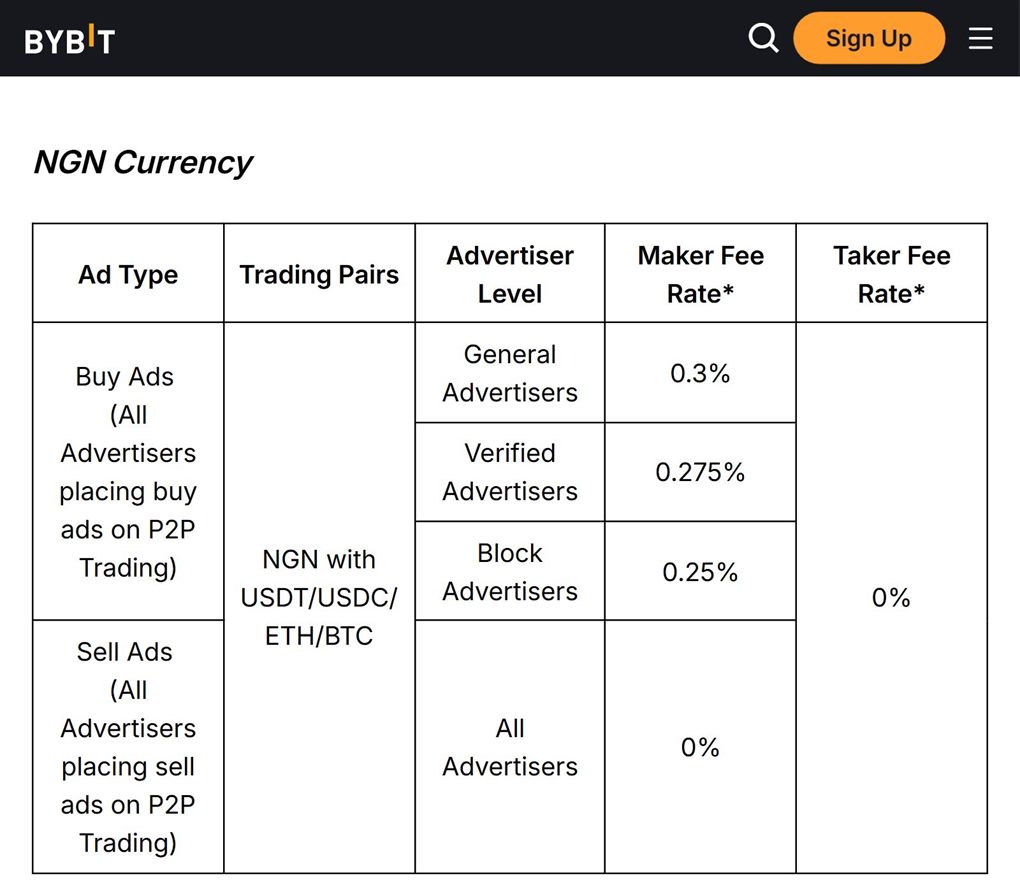 NGN P2P fee table in Bybit's help centre, checked 12 October 2026.
So if you are simply picking an ad and paying, there is no P2P fee. That does not mean the trade is free.
The price gap, which is where most of the cost hides
Every P2P seller sets their own price. The difference between their price and the wider market is called the spread, and it is paid by you, built into the rate.
A made-up example shows why this matters more than any fee. Suppose you spend ₦100,000 to buy USDT. Seller A charges no fee, but offers a rate that gives you 5% fewer dollars than seller B. Seller B charges a small fee. Seller A looks "free" but costs you more.
The only fair test is: how much did I end up with? I have been comparing costs this way for as long as I have traded, and it has never let me down. Compare several ads, and check them against today's naira rates so you know roughly where the market sits.
The quick Buy / Sell screen, where the cost is in the quote
The app also has a quick Buy / Sell screen that skips choosing an ad. Buying USDT there by Bank Transfer carries a small visible fee, ₦25 on a ₦14,500 order in the Bybit app on 12 October 2026. The bigger cost was the rate. It quoted about ₦1,373 per USDT, when the cheapest P2P ads that moment asked ₦1,357 to ₦1,363. Paying by card, Apple Pay or Google Pay through the "Third Party Channel" was dearer still, at ₦1,379.
Selling shows the same pattern, only wider. The quick Sell quote that evening was about ₦1,341 per USDT, while the better P2P buy ads paid around ₦1,360. On 1,000 USDT that is roughly ₦19,000 left behind for the sake of a faster screen.
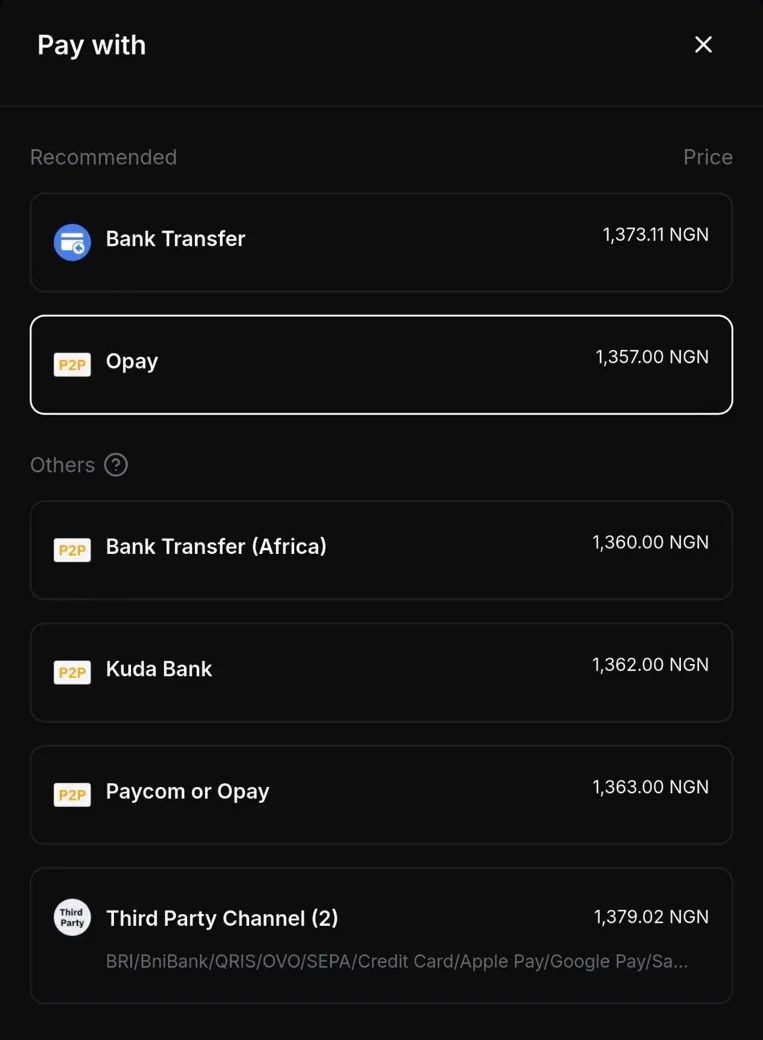 Payment options for buying USDT with naira in the Bybit app, 12 October 2026.
The trading fee, when you swap USDT for Bitcoin
Once you hold USDT, you swap it for Bitcoin on the spot market. Regular (non-VIP) users pay 0.1% on most spot pairs, taken from the coin you receive. Some pairs cost more (Bybit fee page, checked 12 October 2026).
On a small amount this is a few naira. It adds up if you trade often.
Withdrawal and network fees, when you move coins out
If you move coins off the exchange, Bybit charges a withdrawal fee. It is a fixed amount that depends on the coin and the network, and the withdrawal screen shows it before you confirm.
On top of that sits the network itself. Every blockchain charges a fee to move coins, and it depends on the network you choose and how busy it is. Cheaper is not always right. The receiving side must support the same network, or the coins can be lost. Crypto Wallets Explained shows what to check.
Your bank's share
The last cost is the one people forget. Your bank or payment app may charge for sending or receiving naira, and it may have daily limits that force you to split a large trade. Those charges are set by your bank, not by Bybit, so check them there.
Keeping the total down
Most of the saving comes from habits rather than tricks. Compare several P2P ads before you order, because the gap between them is usually larger than any fee, and hold the quick Buy / Sell quote up against them before you take it. Avoid many tiny transfers when each one carries a fixed fee. When you withdraw, pick a network that the receiving wallet supports and that has reasonable fees, and send a small test amount first.
Fees change, so check the current table in the app before you trade. If you do not have an account yet, you can open a Bybit account here (affiliate link) and check the new-user rewards on the sign-up page. The full process, from sign-up to your first Bitcoin, is in How to Use Bybit in Nigeria, and Bybit P2P in Naira covers the P2P side step by step.
Join through our link: get at least 20 USDT in sign-up rewards and 20% off trading fees.
Open a Bybit account and see new-user rewards(affiliate link)